Saturday, April 30, 2011

Daniel Catán (1949-2011)

I studied composition with Daniel Catán for the past semester and since he passed away suddenly a few weeks ago I’ve been trying to think about a proper way to memorialize him in this space. At first I thought that perhaps it wasn’t my place to do that because I knew him for such a short time compared to dozens of other people in his life but, in the end, there are many ways to honor someone’s memory and my time with him meant a lot to me.

When people eulogize someone important to them I feel like it can sometimes veer easily into hyperbolic statements about the faultless virtues of the deceased; clichés can run rampant and nothing much is said about the person in question. But, as with any sort of cliché, it exists mostly because it's probably true. So that being said, I’d like to make the following statement:

Daniel Catán was an amazing human being. Cliché? Yes. True? Totally. And my story about how I came to know him starts a few years ago.

Smash cut to…

…Germany: the summer of 2006. I was on one of those semi-requisite, post-collegiate backpack traipses through Europe with a friend. Via the European train system, we ended up being on the road for about a month and a half and one of our stops was the town of Heidelberg in southwestern Germany. Like most of the places we ended up it was a process of getting off the train, finding and setting up the campsite we had booked and subsequently filling up any remaining time we had by seeing the sights, eating the food and, inevitably, drinking the beer. During this particular stop we were walking through the downtown area and, for probably the third day in a row, I was wearing a shirt from my undergrad choral days that said “Luther College Nordic Choir” on it. The fact that we weren’t able to wear fresh clothes every single day necessitated bringing along the kind of crappy t-shirts that Life sort of gives you once a year (think about it…you have a closet full of them, right?). In any case, as we were walking someone out in the crowd of people shouted, “Nordic Choir?!”

The shouter in question turned out to be a Luther alum who had graduated just a few years before us. He was working in town as a singer for the local state opera at the Theater Heidelberg and he ended up showing us around town, taking us out to eat (I had some crazy good semmelknödel) and eventually securing us comp tickets for that night’s production of an opera called Florencia en el Amazonas. It was sung in Spanish with German supertitles so, due to the fact that I only speak a little bit of either of those languages, it was a bit hard to follow. The beer secured after the first act and a question and answer session with a German couple also in attendance helped clarify things a bit.

And that’s where that part of the story ends. We had a good time at an opera we hadn’t planned to see and only half understood.

Smash cut to…

…Austin, Texas: the winter of 2010. Here I was slogging my way through graduate school and, during registration, it’s brought to my attention that there will be a composer-in-residence for the spring semester. His name is Daniel Catán and he’s been commissioned to write a new opera in honor of some local mega-patrons who gave $55 million to the School of Music (which was subsequently named after them). Supposedly he's written some pretty incredible stuff but I am skeptical at first because I’m a bit wary of signing away 25% of my lessons to somebody I have never heard of before. To this end I bring up his Wikipedia page to investigate a bit more and it becomes obvious fairly quickly that this guy is the Real Deal. Operas produced everywhere; widely respected, etc. In fact, as it turned out, the last thing he worked on was a commission from the Los Angeles Opera to write something for Placido effing Domingo. Whoa. Maybe I should study with this guy after all.


That’s when I scrolled down to the section where it listed all the operas he had written. There, listed amongst the others, was Florencia en el Amazonas; the opera I had seen by pure coincidence in the summer of 2006. The composer of that piece (whose name I had long forgotten) was Daniel Catán.

I took this as a sign and immediately put my name in the hat to study with him. “He’ll have some incredible advice on that opera I’ve been writing for the last few years,” I thought.

From the very first lesson (in which I recounted my story of seeing Florencia in Heidelberg) it became starkly evident that Daniel was an incredible human being who, through his compositions, wanted to take as many people on a beautiful journey as he could and he cared deeply for all of his students as both people and fellow composers.

For the uninitiated, I feel I should say that sometimes music lessons can devolve into a sort of empirical hegemonic exercise whereby a student is instructed by a master but, every Wednesday at 3pm, Daniel made it known through no uncertain terms that he considered his students equals and this was the position he wanted to talk about my music from. He would often lean forward, point at various measures on my chicken scratch manuscript and gently ask, “What are you trying to say here? I just want you to talk for a bit and I’ll listen.”

He was gracious and he was challenging but, above all, he was nurturing. Not every composition student needs this but, in my case, it helped me to get work done because I didn’t dread showing my music to him (and I hate presenting my music to other composers). We would often just sit and talk for a while; spending maybe 10 minutes of the hour on actual music I brought in. We talked variously--and for no apparent compositional reason--of a Norwegian dessert called rømmegrøt I had recently made for a dinner party as well as the different ways he felt Musetta could be played in any number of productions of La bohème (clearly he was the one who was on-task). At one point he found out that I played banjo and grilled me on notation for that instrument because he had planned on using it in the opera he was working on.

At our final lesson together, I brought in a piece for viola and piano I had written. I played it for him and he said, “Well, it doesn’t sound like you’re stuck on this. What else have you brought?” As this was 15 minutes into our lesson I freaked out a little because I didn’t know what I could play for him but, as it happened, I had the 50 pages of music I've got written for my opera, We, The Boys, with me. I took it out and he proceeded to school me at length on what I was doing right and wrong. At one point, he looked at me and said, “This is a song. You’re inspired by the troubadours, aren’t you?” I had to honestly say that I wasn’t...and I’m unsure if I’ll ever be compared to a composer of Occitan lyric poetry in the High Middle Ages again in my life. It’s certainly something to strive for.

In a sense, though, he was right. I’m woefully unfamiliar with the canon of troubadour music (for the moment), but the music of various singer/songwriters is something that informs my music in a deep way. And couldn’t modern-day musicians like Holcombe Waller or Ben Gibbard or Justin Vernon (to name a few) be said to have a connection to that ancient music. I definitely think so and he had heard the residue of those people in the aria I played for him. But that was Daniel Catán for you. He was one of the most perceptive people I have ever met.

He also had a wicked sense of humor that was as dry as the desert sand. It always took a second to figure out that he was even telling a joke in the first place because he wouldn’t say it any differently than he would any other sentence. During one of our lessons I was telling him about a new opera that I was excited about. He sat and quietly listened until I finished the story about the plot of the piece. Once I reached this point you could sort of see the gears turning in his head before he very calmly--and without a trace of invective or hyperbole--said, “You know…[beat]…this sounds like fucking bullshit to me.”

He was incredibly funny.

Also, due to the fact that he grew up for a time in the United Kingdom, he would often pepper his speech with the word “bloody.” He was born in Mexico but had lived as an English speaker for the majority of his life so he had this sort-of muddled Spanish accent that was hard to place. But here he was talking about how things were “bloody difficult” or “bloody great.” The passion of a Hispanic man crossed with the erudition of an English toff. Whenever I tried to imitate him I ended up sounding like a cross between Antonio Banderas and a leprechaun (I am not a very talented mimic).

And I will miss him dearly. As clichéd as this sounds, I learned more from him in our short time together than I had in the previous 10 years. He made me feel as if some of the decisions I had made about being a composer--decisions that I attribute to just blindly feeling my way around that particular endeavor--were the right ones and that, in fact, he toiled in the same proverbial vineyard as I did. The overwhelming message was, "Just write what you want to write. Everything else will take care of itself as long as you're truly happy with what you've written." And it’s not often that you find a compositional mentor that attempts to impart this very simple notion to you.

In talking with his other students, it turns out he had the same effect on them as well. He had the talent of saying the exact thing that needed to be said. Without malice or pretense he encouraged us all to be the composers that we were rather than the composers we wanted to be (and there is a vast difference between those two). To quote the beautiful obituary that Mark Swed wrote in the Los Angeles Times:
Everyone--even the singers and stage directors and opera administrators--liked him. Critics and some important people in the music business were put off by Catán’s unabashed neo-Romanticism, but no one had a bad word to say about him. His students adored him. He always struck me as someone who cared about people and who cared about music and had no intention of letting one form of caring obstruct the other.
Very, very true. One of the things that Daniel was quoted as saying is, “Love and art are the vehicles to self-realization as a human being in the fullest sense of the word.” Just take a second and figure out what that statement means to you.

Those words have resonated with me since the very first time I set eyes on them both because I was lucky enough to know the man that said them...but even more so because I think they’re bloody true. Love and art represent emotional purity and, ultimately, the power of truth. It’s a notion that I think he strived--sometimes willfully, doggedly so--to live up to. And that might be the noblest endeavor that anyone can undertake whether they write incredible operas or not.

Gracias por todo, Señor Catán. Te echaremos de menos.

Thursday, February 24, 2011

robert henri + i'm dating an old model

Myself and a bunch of other composers have just been commissioned to write a piece each for the Blanton Museum of Art and last week they had us all out to view the pieces--all in the permanent collection--that they'd like us to respond to. The scope of the project and the long-term involvement with the museum's archives is still being worked out but I'm excited that I get to work with a painting again. Last time I was asked to write with a piece of visual art in mind I got to know Gregory Euclide's floor bloom drop needles in a profound way and the resultant piece of music yielded a trip to Seattle where, amongst other things, I tooled around the city in one of those boat/truck thingies and learned that the local economy was propped up during the old days by taxes on hookers. That probably won't happen this time around (never say never, though...) but, at the very least, I'm completely satisfied with a free tour of one of the largest repositories of art in the bigass state of Texas.

The museum had prepared a list of pieces for us to start with and the first stop was Cildo Meireles's How to Build Cathedrals. From the outside of the work it looks--at least to my eye--flowing and restful and beautiful and contemplative and what-have-you. However...


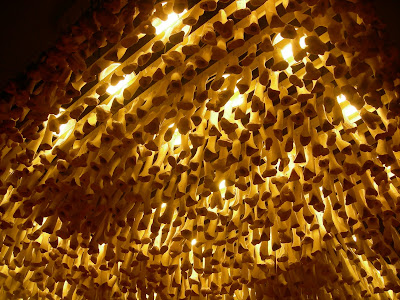
...once you step inside it's patently obvious that it's quite a bit more macabre than it looks at first blush. There are hundreds of cattle bones hanging from the ceiling...


...and $6,000 worth of pennies littering the floor. These two aspects of the piece are connected by a column of communion wafers so, as you can imagine, it's fairly political. Check out the museum's page on it if you're game. It's quite interesting.


They took us all around the museum and the works of art ranged from the 20th century all the way back to pieces from the 1600s.


The painting I ended up choosing was Robert Henri's The Old Model. It wasn't on the Blanton's initial list they had proposed but there's something incredibly beautiful about her gaze as well as the brushwork.


After staring at this for a while I feel as if someone else in my position might try to find out about her but I ended up deciding that I won't do that. She has a sort of quiet dignity that's starkly evident right there on the canvas and that's enough for me.

What I did end up looking in to was Robert Henri himself and the results were fascinating. On a side note, I initially pronounced his name in the French manner until I found out that he was, in fact, an American artist. It seems that years of language-centric vocal training has completely fouled my ability to not think in a pretentious manner.


Turns out he was a patriarch of sorts to the Ashcan School of painters that worked to depict the lives of poor people (mainly in New York City) in the early part of the 20th century. Here's a great picture that Wikipedia yielded of what appears to be the lot of them just hanging around John French's studio.


A good example of Henri's work is his 1902 painting, Snow in New York. It definitely seems to fit with the description of Henri's philosophy that he "wanted art to be akin to journalism. He wanted paint to be as real as mud, as the clods of horse shit and snow, that froze on Broadway in the winter." I can dig that.


One of the more interesting things about Henri is that he was a passionate teacher as well and it turns out he wrote a book on the subject called The Art Spirit which I now have in my possession. After cracking the first two chapters it was pretty obvious that I had made the right choice because the writing is wonderful. In fact, I think I should probably get my own copy because the urge to mark up the library one I have now is fairly strong. It reminds me of when I read Rainer Maria Rilke's Letters to a Young Poet a few years ago. Check this little nugget out:
"Know what the old masters did. Know how they composed their pictures, but do not fall into the conventions they established. These conventions were right for them, and they are wonderful. They made their language. You make yours. They can help you. All the past can help you."
You'd have a hard time figuring out what type of artist said that, right? It might as well have been a composer or a choreographer or a playwright for all we know. It's certainly not anything new by any means but, in verbalizing it in such a sober and dramatic way, it makes what he's saying sound almost mystical; as if it were part of a ceremony. "All the past can help you." That could easily be straight out of Tolkien (which I still have yet to read).

But, frankly, I like it when great artists get all professorial about their art. It makes me feel a deeper connection with the past and, for some reason, I feel like it gives my own struggles as a composer some sort of validation. This may or may not be the journey that my colleagues will go on with their own respective works of art, but it has somehow turned out to be mine. Me and Robert Henri and his old model are going to spend some quality time together.

Now, having written this entry, I think I'll heed Henri's advice and get to work:
"It is not enough to have thought great things before doing the work."
Agreed, sir. Res ipsa loquitur.


Saturday, February 19, 2011

dalla$ + currently listening

Time to clear the stable of bloggable nonsense so I can write some stuff that's actually substantive here in a few weeks. I've got two new pieces to write about (one of which is a really interesting collaboration with the Blanton Art Museum) and I need to get this off my chest: I saw Ke$ha in Dallas on Super Bowl weekend. Holy shit, it was awesome. Her shirt, as you can see, appears to say: "I ate the worm."


A friend secured us some free VIP tickets for a huge private-ish party that Bud Light put on the day before the Super Bowl. I usually hate hanging out with douchey, rich people (someone told me that tickets were going for $400) but since we got ours for free and the acts were going to be crazy good, we drove the three hours up to Dallas-Fort Worth.

The concert featured Pitbull (who I had never seen but really enjoyed), Ke$ha (res ipsa loquitur) and Nelly (who I had also never seen) and being surrounded by drunken people gyrating to the insane concert that they put on was probably the second funnest part next to the ridiculous spectacle on stage (she played a theremin at one point...a theremin!). Here's a picture from the concert I pulled off the interwebs that shows her playing a guitar shaped like an assault rifle. See that cannon-looking thing on top of it? I'll bet that's a flamethrower for arena shows.


The show was held in downtown Dallas inside a massive tent in the parking lot for the Aloft Hotel which had been bought out by Anhesuer-Busch and re-christened The Bud Light Hotel. You can guess what they served there but, aside from swilling shitty beer, I had what amounts to the most expensive ($14), smallest (tiny plastic cup) and best Long Island Iced Tea of my life (only top shelf booze for a Ke$ha concert, my friends).

So, I went to a Ke$ha concert and had a blast. I sang my voice ragged and danced like it was the end of the world (as is my wont) before heading back to graduate studies and Baroque counterpoint. It was a great distraction. There was even this old dude in a hilarious (but, sadly, not ironic) red sequined shirt walking around that totally made the paper the next day. That's the closest I'll probably ever get to going to the actual Super Bowl and probably the most exclusive party I'll ever attend. It was pretty damn epic.


In other news, I just got Jónsi's new DVD, go live. It's a recording of his go tour's stop in London and it's the same show I saw in Minneapolis last May and Austin last November. There are some interpolations of rehearsal footage that lend to a really interesting--if occasional--documentary feel but the live album that comes with it is totally worth it for no other reason than that you get a few tracks that weren't on the studio version of go. "New Piano Song" is way more interesting than it's title would suggest and "Stars In Still Water" is an absolutely perfect song; it could be performed at a campfire or in an amphitheater. Hearing go rendered live in its entirety is interesting enough...but those two songs alone are worth the price of admission.

Sunday, January 23, 2011

presidential visit

One of the really cool things about where I live and work now is that Lyndon Johnson's presidential library is right across the street. For some nerdy reason, I became an armchair presidential historian a few years ago (mostly due to my quasi-obsession with The West Wing) so the ability to just walk across the street and see this thing satisfies my fetish for all things presidential. The George H. W. Bush Library is only a few hours away so, at some point, it might be fun to go see that as well.
The Herbert Hoover Presidential Library is in Iowa and, having been there on a middle school field trip, I will say that the LBJ one is much more impressive (as you'd predict). Here are a few pics I snapped whilst walking through. Included are:
  • A moon rock.
  • LBJ's bowling ball.
  • The teletype hotline thing used between the White House and the Kremlin during the Cold War.
  • A portrait of LBJ etched out on a whale tooth (what presidency is complete without one of those?).
  • Racist signs.
  • The presidential limousine.
  • The fumbly animatronic version of LBJ which tells jokes (and creeps you the hell out).
  • The Great Hall where all of the archives are kept.
  • The insanely un-stylish furniture in the Oval Office at the time. The replica is at 1/8 scale for some odd reason and kind of claustrophobic to walk around in.


It was a massively fun way to spend an afternoon. I didn't really have a good idea what he did during his time as president other than my tacit knowledge of the Vietnam War so it was really interesting to see the exhibits. Homeboy helped found the National Endowment for the Arts. Holla!

Saturday, January 15, 2011

currently listening

Christmas is always good because I usually end up with a bunch of gift certificates which, in one way or another, feed my terrible addiction to downloading tons of new stuff. First off, Robyn's Body Talk is on loop when I'm running through downtown Austin. This album has been on every "Best of 2010" list I've seen and it's not hard to understand why. Club-ready and kickass. "Call Your Girlfriend" and "Love Kills" are two favorites but I love bubble gum vibe of "Fembot."


I've been listening to a lot of electronic stuff lately while I engrave stuff into Finale and the new Deadmau5 album, 4x4=12, is pretty prominent in the mix. "Animal Rights" is my favorite cut but, if you don't know anything by this guy, you need to check out the track "Strobe" from his album, For Lack of a Better Name. It's almost 11 minutes long with one of the most intense crescendos I've ever heard.


I also sat through an obligatory viewing of Tron:Legacy with my college friend (and brilliant cellist), Eric. That movie was stupid, y'all. Like truly dumb. But the soundtrack is incredible. "The Game Has Changed" makes me want to get all Mason Bates symphony/electronica and "Derezzed" has this throwaway chromatic drop that gets me every damn time. It never comes back so its effectiveness is never diluted. Brilliant.


The last entry from the electronic front is Minneapolis dubstep prodigy, Vaski. He entered the scene at what seems to be the exact right time because it blew the hell up pretty much immediately after he started making records. The title track from the World On Fire EP is absolutely incredible but his other EPs are pretty good too.


Son Lux's Weapons EP is an exploration of one of the standout tracks from his full-length At War With Walls and Mazes. I saw him a few years ago in a concert with Nico Muhly and it's good to hear some new stuff. In fact, Nico's "remix" is probably my favorite track what with the frenetic viola writing.


On the quasi-ambiant front, composer Hugh Lobel totally hipped me to the Danish group Efterklang. Their album, Tripper/Springer, will fill the void in the time it takes for Sigur Rós to come out with some new stuff. I love the one-two punch of "Doppelgänger" followed up by "Torturous Tracks."


And last-but-in-no-way-least is the incredible new album of music by Morten Lauridsen that The Singers - Minnesota Choral Artists just put out. The amount of his music that has been recorded over and over and over again is absolutely staggering but here Matthew Culloton & Co. manage to add some startling new entries from the 1970s that are so rarely performed that these are actually the world premiere recordings. "Three Psalms" is finally heard in its entirety (Stephen Layton and Polyphony recorded a great version of the first two movements a few years ago) and his Four Madrigals on Renaissance Texts is on record for the first time since it was written in 1970. (The central two movements of that cycle are my absolute favorites on this album.)


And, in the way of diversity, the a cappella "Slow, Slow Fresh Fount" is a lot thornier than we're used to hearing from Lauridsen. It points forward to the music he would write in the Madrigali as well as his brilliant Mid-Winter Songs. If you have a minute you should hop on iTunes and take a gander. It's Lauridsen like you've never heard him!

Sunday, December 19, 2010

jay brannan @ lambert's

I went to see Jay Brannan sing a gig at Lambert's here in Austin last week and I am so glad I took the time to go. I've loved his stuff ever since he had that hilarious-but-poignant song on the Shortbus soundtrack and somebody took the time to sit me down and make me listen to his debut LP, Goddamned. He does pretty much every part of the business of being a musician himself so he can actually make a living off his music and that's something that, as a composer, I can definitely connect to. The space he played in was completely sold out but incredibly intimate and, consequently, there wasn't a bad seat in the house. Before the show he was walking around chatting with people and drinking tea so I got a chance to thank him for his song, "Death Waltz," because what it's really about is my struggles with writing music...not whatever it is he thought he originally wrote it for.

Anyway, since it was such a small venue I got to see one of my favorite singer/songwriters from only about six feet away. Totally cool.


Thanks, Jay. Hurry along with a new album, will you?

Friday, November 26, 2010

currently listening

Did everyone get Ra Ra Riot's new album? Holy shit it is so good. "Boy" is probably my favorite song (I'm always impressed when Wes Niles belts out a high B so effortlessly) but "Too Dramatic" (with its little cowbell thing around 2'30") is a close second. I've seen this band twice (in Minnesota and Michigan) but I had to be somewhere on their last stop through Austin. Hurry back!


In further demonstration with just how cool she is, Jocelyn Hagen sent me Rihanna's Loud for my birthday this year. Why have I not been listening to this stuff until now? It satisfies my Need for Phat Beatz really well and I'm excited that I've got four previous albums to wade through at some point. "S&M" kicks total ass and "Cheers (Drink To That)" might be my new favorite Song for Boozin' It Up. Mahalo.


And Ke$ha's new album, Cannibal. Oh, Ke$ha's new album. Damn I love this girl. I've found it's really good music for writing Renaissance counterpoint to. $eriously. "Blow" will knock your brains out and "Crazy Beautiful Life" is actually really heartfelt. When I need to wake up in the morning this album is on repeat.